
Young people’s mental health improves in Northern Ireland but girls report higher loneliness levels
Youth mental health in Northern Ireland has improved in several areas since 2022, according to new Department of Health statistics, although more than a quarter of pupils continue to show signs of loneliness.
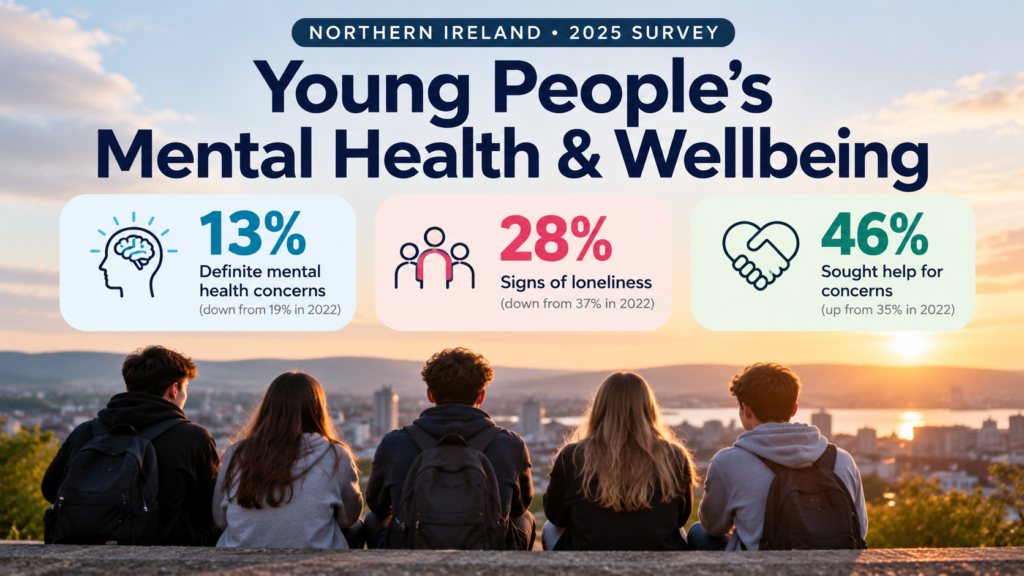
The findings, published on Friday 30 October, come from the 2025 Young Persons Behaviour and Attitudes Survey, which examined the experiences of school pupils aged 11 to 16.
The proportion of young people reporting definite concerns about their mental health fell from 19% in 2022 to 13% in 2025.
Meanwhile, the proportion showing signs of loneliness decreased from 37% to 28% over the same period.
However, the figures also reveal differences between boys and girls, with girls reporting higher levels of loneliness, lower wellbeing scores and greater use of social media.
Northern Ireland youth mental health survey shows improvements
The latest findings indicate improvements across several measures of mental health and wellbeing.
When asked whether they had ever experienced concerns or worries about their mental health, 13% of respondents said they definitely had, compared with 19% in 2022.
A further 34% said they had experienced concerns to some extent, compared with 32% in the previous survey.
Taken together, the results indicate that 47% of respondents reported at least some concerns about their mental health.
The survey also measured mental wellbeing using the Warwick-Edinburgh Mental Wellbeing Scale.
The average score increased from 21.1 in 2022 to 22.3 in 2025, with higher scores indicating better mental wellbeing.
Although the findings suggest improvements, the figures also show that mental health concerns remain common among young people.
More young people seeking help for mental health concerns
The survey found an increase in the proportion of young people seeking support for their mental health.
Among respondents who reported concerns, 46% said they had sought help, compared with 35% in 2022.
Family members were the most common source of support identified by young people.
For those who had not sought help, the most frequently reported reason was believing they could manage their concerns themselves.
The findings suggest that more young people are reaching out for support, although a substantial proportion of those experiencing concerns are still not seeking help.
More than one in four pupils show signs of loneliness
Despite an overall improvement, loneliness remains a significant issue among young people in Northern Ireland.
The survey found that 28% of respondents scored six or more on the UCLA Loneliness Scale, indicating signs of loneliness.
This represents a decrease from 37% in 2022 and is similar to the 30% recorded in 2019.
Girls were considerably more likely than boys to report loneliness.
More than a third of girls, 37%, showed signs of loneliness, compared with 20% of boys.
Girls were also more likely to report feeling left out, alone or that they had nobody to talk to.
The survey found that girls had a lower average mental wellbeing score than boys.
Social media use widespread among Northern Ireland pupils
Social media was another major focus of the survey, with 97% of respondents reporting that they used at least one social media platform.
Among those using social media, 88% said they accessed it daily or on most days.
The findings also revealed differences in how much time boys and girls spent online.
On a typical school day, 65% of girls reported spending more than two hours on social media, compared with 54% of boys.
Girls were also more likely to compare themselves with others online.
Almost half of girls, 47%, reported making comparisons with other people on social media, compared with 19% of boys.
While the findings identify differences in social media behaviour and mental wellbeing, the survey does not establish that social media use is responsible for poorer mental health outcomes.
Survey involved pupils across Northern Ireland
The Young Persons Behaviour and Attitudes Survey is a school-based study examining the experiences of pupils aged 11 to 16 in school years 8 to 12.
The survey has been conducted periodically since 2000, with the latest round taking place between September 2025 and February 2026.
A total of 8,875 pupils completed the wider survey, which covered a range of topics including health, education and behaviour.
The questions on mental health and wellbeing were included in one of three questionnaire versions, completed by 3,034 pupils.
The research was carried out by the Northern Ireland Statistics and Research Agency on behalf of government departments.
Responses were weighted to reflect the composition of Northern Ireland’s post-primary school population.
The Department of Health says the latest results provide evidence to help inform policy and understanding of young people’s mental health, wellbeing, loneliness and social media experiences.
The findings highlight improvements since 2022 while also identifying areas where young people, particularly girls, continue to experience challenges.
External link: Department of Health — full 2025 mental health and wellbeing survey findings.
Other news: Northern Ireland launches new 10-year framework for children’s mental health and wellbeing