
Queen’s University Belfast astronomers uncover new clues about mysterious objects near Neptune
Astronomers at Queen’s University Belfast have led international research into elusive icy objects that share Neptune’s orbit, providing new insights into the evolution of the solar system.
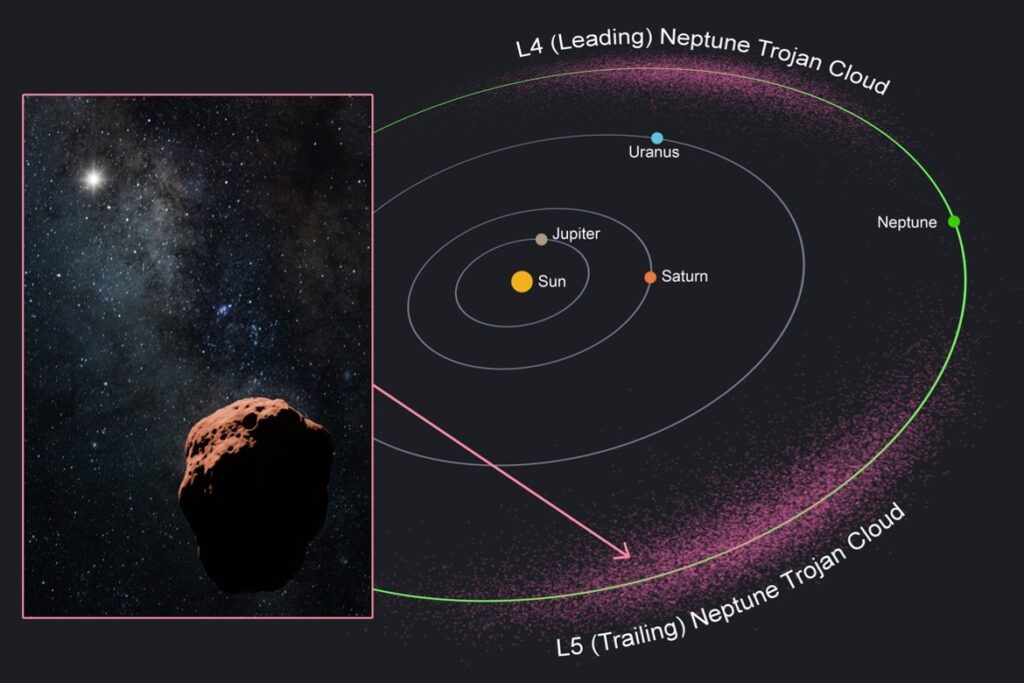
Artist Rendition Credit: FlyAzure/J.Murtagh/NASA/JAXA:
The research focuses on Neptune Trojans, small bodies that travel around the Sun in stable regions associated with the eighth planet.
The findings were reported in The Astrophysical Journal Letters and announced by Queen’s on Wednesday 28 October 2026.
What are Neptune Trojans?
Neptune Trojans are small icy objects that orbit the Sun alongside Neptune.
They occupy gravitationally stable regions known as Lagrange points, situated approximately 60 degrees ahead of or behind the planet.
These locations allow objects to remain in broadly stable orbital relationships with Neptune.
Studying them can help astronomers understand how material was distributed during the early history of the solar system.
Queen’s researchers use powerful observatory data
The international team analysed observations from the NSF–DOE Vera C. Rubin Observatory in Chile.
The research confirmed two objects and identified another candidate associated with Neptune’s trailing Trojan population.
The observatory’s wide-field surveying capabilities are expected to improve astronomers’ understanding of faint and distant solar system objects.
The findings contribute to research into the formation and migration of the outer planets.
Belfast research contributes to planetary science
The discovery highlights the role of Queen’s University Belfast in international astronomy research.
Neptune Trojans are difficult to detect because of their great distance from Earth and comparatively faint appearance.
Improved observations may help researchers build a more complete picture of their population and origins.
Further studies will be needed to refine the understanding of these objects and what they reveal about the solar system’s early development.
Other news: Queen’s Belfast joins €300m European Solar Telescope project to study the Sun
External link: Queen’s University Belfast